Google Slides & Sheets, Canva, Google Forms; shared via Discord
Deliverable
A mobile-first "Rugby League 101" kit: slide deck, cheat sheet & intake tracker
The Challenge
A sport almost no one in the US arrives already knowing
Rugby league is largely unknown in the United States. New adult players join the Barracudas with little or no exposure to the game, and the club's only onboarding was in-person coaching and word of mouth.
That created friction at exactly the moment that decides whether a recruit stays: the first few sessions. New players were unsure of the rules, their position, and what was expected of them; volunteer coaches repeated the same basics every season; and nothing existed to help a nervous newcomer prepare before showing up. For a volunteer-run club trying to grow the sport, that friction costs both recruitment and retention.
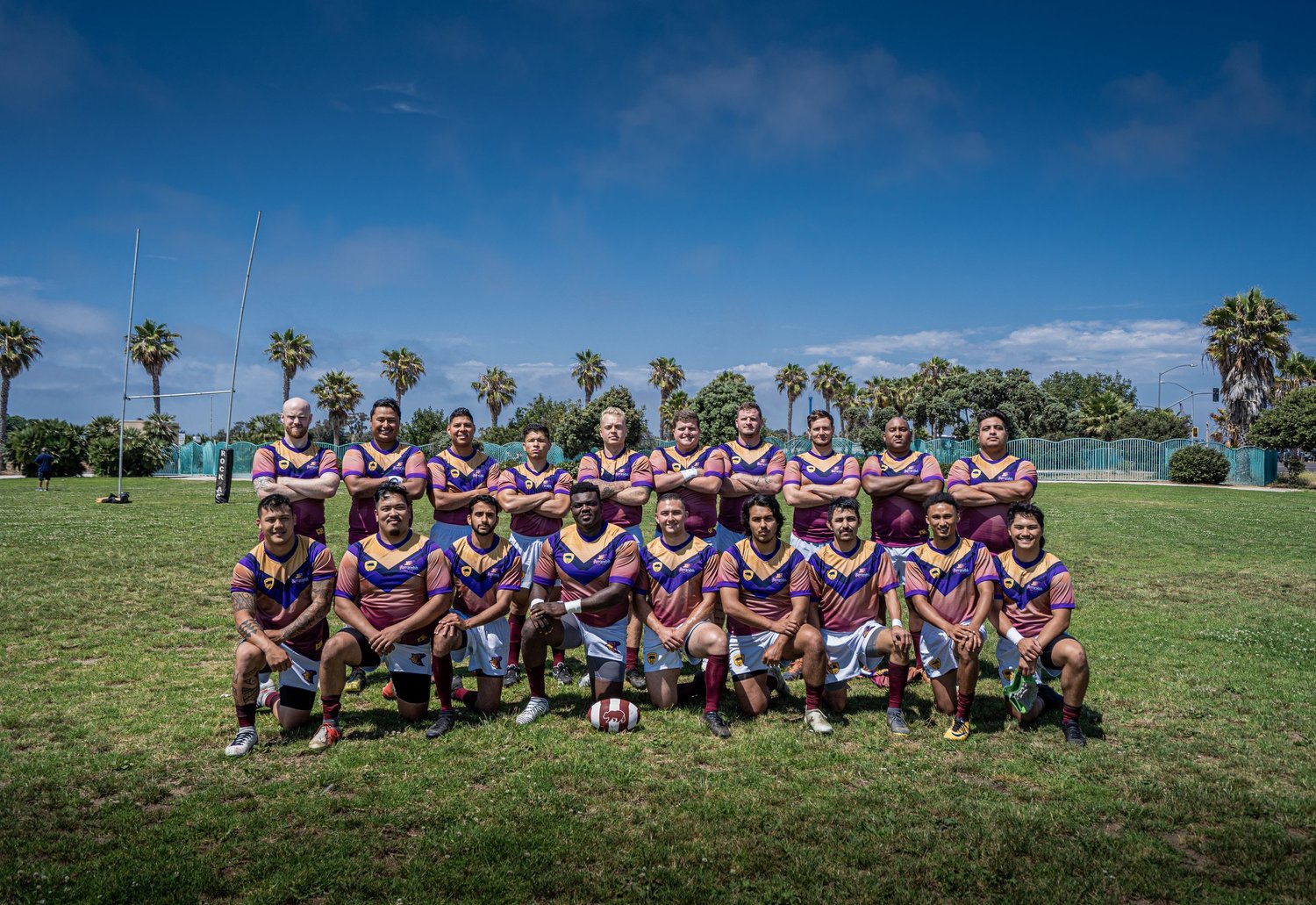
The San Diego Barracudas, the city's first rugby league club (est. 2021), field men's and women's sides and are growing the sport in Southern California. Photo: San Diego Barracudas.
Discovery & Research
I started with the learners, not the content
I had an advantage most designers don't: I was also a volunteer assistant coach at the club, so I saw the friction on the field firsthand and had direct access to the learners. I still started formally, with an organizational analysis (mission, audiences, communication channels, and friction points) and a short Google Form surveying new and recent players, asking how they preferred to learn, what confused them, how confident they felt, and what got in their way.
What the new players told us
"Being shown in practice"
The most preferred way to learn, kinesthetic first, with short video and a quick guide as backup.
Play-the-ball & restarting after a tackle
The single biggest source of confusion, alongside the overall flow of the game.
Time was the top barrier
Named repeatedly, together with inconsistent attendance. Anything built had to be short and mobile-friendly.
Several came from rugby union
First-game confidence skewed low (several self-rated 2 of 5), and many were "still confused" about their position.
Responses were anonymous; findings are reported in aggregate.
The Insight
For ex-union players, prior knowledge was working against them
The research surfaced a problem most onboarding ignores. Several of the surveyed recruits already played rugby union, a different code with conflicting rules. Their instincts (contest every tackle, unlimited possession, ruck over the ball) are exactly wrong in rugby league. In learning terms this is negative transfer: existing knowledge actively interfering with new learning.
So the design had to do two jobs at once: build a clean league mental model for true beginners, and actively unlearn union habits for the experienced players, without confusing or alienating either group.
The design isolates these contrasts on purpose, so old reflexes get corrected instead of quietly reinforced.
The Solution
A hybrid "Contrast + Stand-Alone" onboarding design
Rather than one generic rulebook, I designed a sequence that teaches league cleanly while surgically addressing union carry-over only where it helps:
The four-stage sequence: orient everyone fast, teach league cleanly, drill it live, and leave a reference behind.
Intro micro-lesson: "Same ball, different game"
A 2–3 minute video / one-pager with a side-by-side graphic of the six biggest league-vs-union differences. Orients everyone fast.
Core league modules, taught independently
Tackle count & set completion, play-the-ball mechanics, the 10-metre onside line, positions & roles, and restarts & penalties, each standing on its own so true novices are never lost.
Optional "union contrast call-back" in each module
A clearly marked box that lets ex-union players connect (and correct) the dots, without derailing beginners who don't need it.
On-field scenario drills
Mixed-team drills act out common infractions; the coach calls "Union brain!" when an old reflex appears, turning negative transfer into a shared, low-stakes joke.
Quick-reference cheat sheet
Front: league fundamentals. Back: the "union traps" to avoid. Built for the phone, for players short on time.
The contrast at the heart of it
Rugby league versus the rugby-union habit, contrast by contrast
Situation
Rugby league
Rugby union (the old habit)
After a tackle
Play-the-ball restart
Ruck / contest on the ground
Tackle count
Six tackles, then hand over
Unlimited
Contesting the ball
Rarely contested; you keep your set
Contested at every breakdown
Defensive line
Retreat 10 metres
Offside at the ruck (≈ at the ball)
Restart / scrum
Uncontested
Contested
Drop goal value
1 point
3 points
The cheat sheet (concept)
Front · League fundamentals
Six tackles, then hand over
Play-the-ball to restart
Retreat 10 metres on defence
Know your position and role
Back · Top union traps
Don't contest the tackle
Don't ruck over the ball
Possession isn't unlimited
Drop goal is worth 1, not 3
The pocket cheat sheet, designed for the phone: fundamentals on the front, the union habits to unlearn on the back.
Designed Around Reality
Every choice traces back to what the learners said
"Time" was the top barrier, so the assets are short, modular, and mobile-first, usable in the gaps before or after practice.
Players learn best "being shown in practice," so the digital pieces support and reinforce on-field coaching rather than trying to replace it.
Play-the-ball was the #1 confusion, so it gets its own module and a prominent place on the cheat sheet.
Confidence going into a first game was low, so the sequence front-loads orientation and "what to expect" before rules detail.
Why this matters
Grounding the design in a real learner survey, not assumptions, is what turns "make a rules guide" into a targeted solution that removes the specific friction stopping new players from coming back.
Delivery & Measurement
What I handed off, and how it gets measured
I worked in a rapid ADDIE cycle with action mapping, keeping every piece tied to an on-field behavior: building the assets in Google Slides and Canva, running the intake survey through Google Forms, and packaging everything so the club could push it straight to players through Discord.
I handed the club a complete, editable onboarding kit: the sequenced Rugby League 101 deck, the "Same ball, different game" contrast, the pocket cheat sheet, and an intake-tracker spreadsheet that runs the pre/post confidence math automatically, plus all source files, so volunteers can run and maintain it without me.
From the actual deck
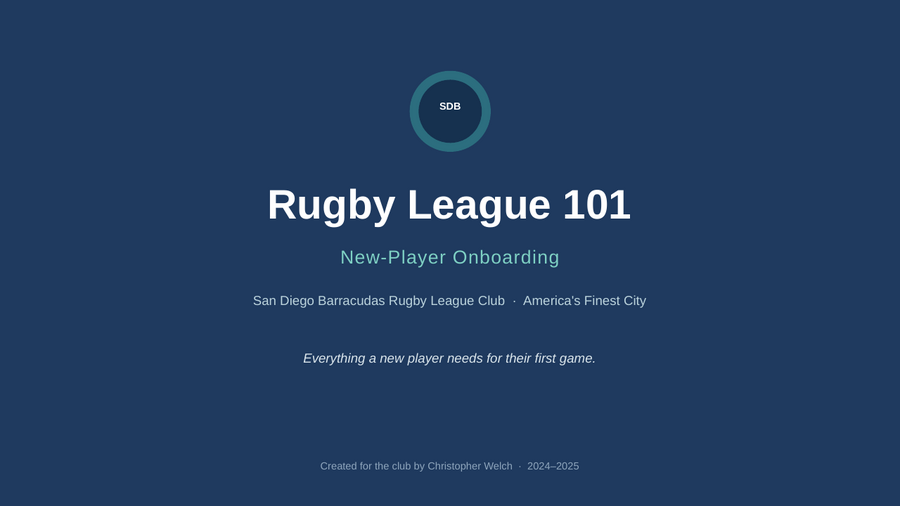
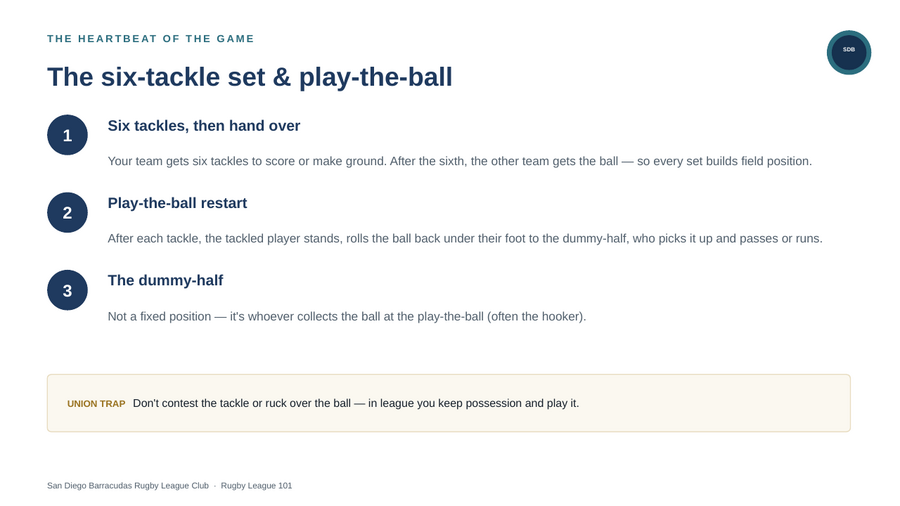
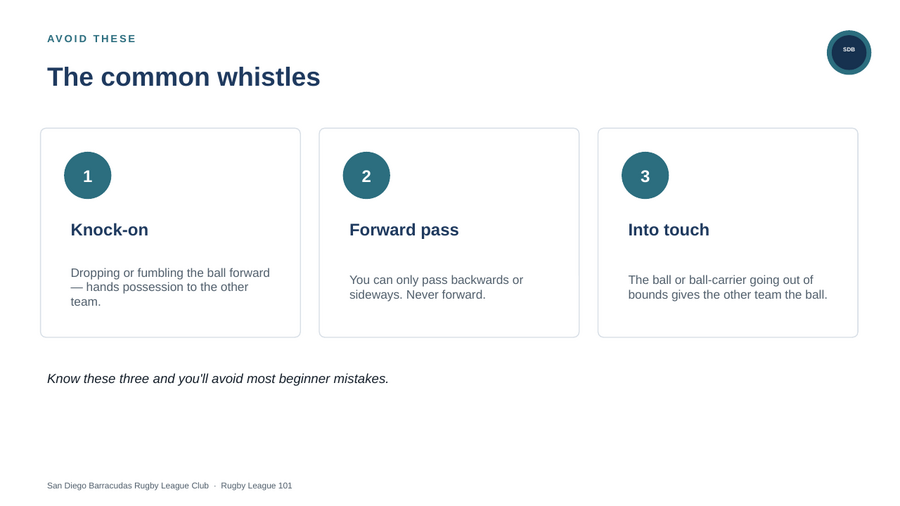
Three slides from the delivered deck: the branded title, the play-the-ball core with its "union trap" call-out (negative transfer, handled in-line), and a clean rules card. Shown as excerpts; the full kit is the club's property.
Measurement, built in
Rather than bolt evaluation on afterward, I designed it into the program. The intake survey's 1–5 confidence question doubles as a repeatable pre/post measure, so the club can track, each intake:
New-player confidence before a first game (the same 1–5 self-rating, run pre and post).
New-player retention into a second season.
Coach time spent re-explaining the basics each session.
The work also landed amid real momentum for the club: the Barracudas field men's and women's sides, called 2024 their biggest season yet on the back of an expanded sponsor roster, and launched a youth program, BarraKiddos, in December 2024, the growing pipeline of new players this onboarding is built to serve.